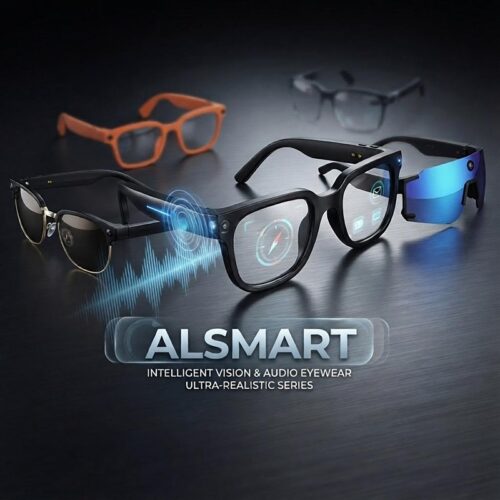
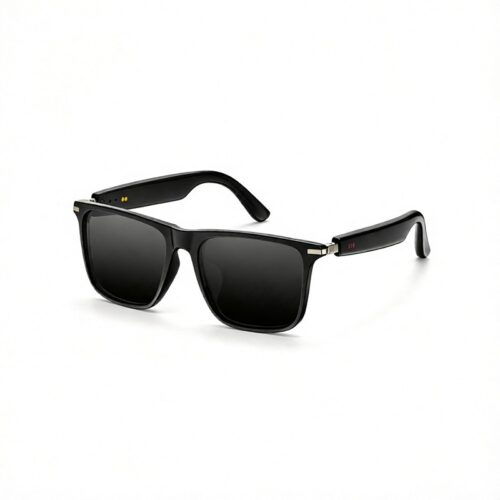
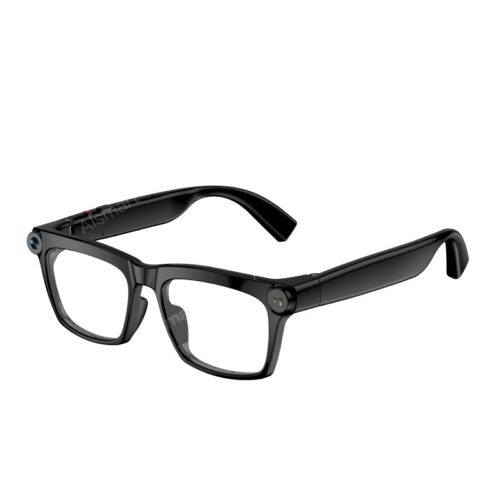
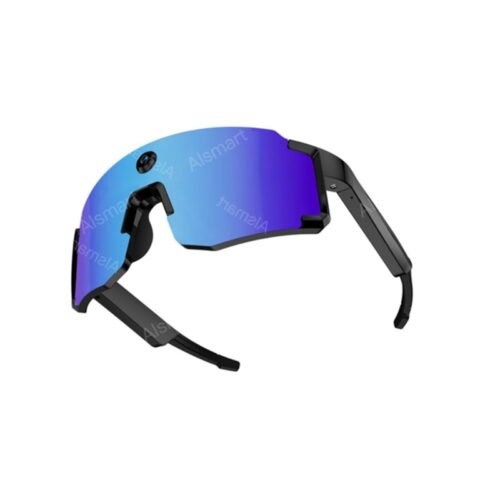
Beyond Displays: How AR and AI Are Shaping the Next Generation of Smart Eyewear
As wearable technology continues to evolve, Augmented Reality (AR) smart glasses are moving beyond simple information displays toward more intelligent, context-aware experiences.
One important development is the integration of Artificial Intelligence (AI) with AR technology. While traditional AR smart glasses focus primarily on presenting digital information within the user’s field of view, AR + AI smart glasses aim to combine visual information with intelligent assistance, voice interaction, and, where supported, real-time environmental understanding.
For businesses evaluating next-generation wearable devices, understanding these differences is essential for selecting the right technology for specific applications.
1. What Are AR Smart Glasses?
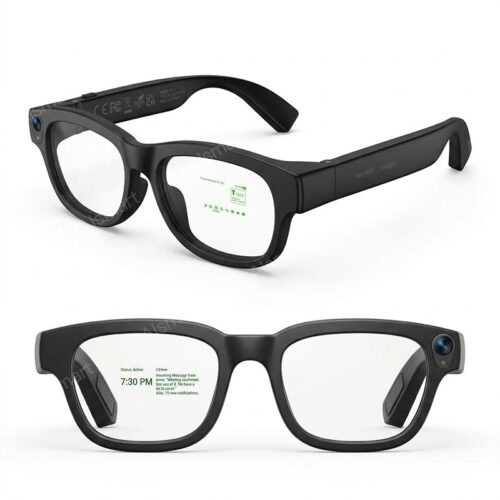
AR smart glasses use optical or display technologies to present digital content within the user’s field of view, allowing digital information to complement the physical environment.
Depending on the design, these devices may use waveguide optics, optical combiners, or other display technologies. Common functions include navigation prompts, notifications, translated text, meeting information, and hands-free access to instructions.
Key advantages
- Hands-free information access: Users can view relevant information without constantly checking a smartphone.
- Improved workflow efficiency: Instructions and reference information can be available directly in the user’s field of view.
- Reduced interaction interruptions: Visual prompts can support tasks that require users to keep their hands free.
- Potential for enterprise integration: AR interfaces can support logistics, field service, training, inspection, and remote assistance workflows.
Limitations and challenges
- Display constraints: Field of view, brightness, resolution, contrast, and readability can vary significantly between products.
- Limited intelligence in basic implementations: A display alone does not automatically understand the user’s environment or provide contextual recommendations.
- Battery and thermal constraints: Display operation, wireless connectivity, and processing all consume power.
- Integration complexity: Enterprise deployment may require compatible software, secure data connections, and customized workflows.
AR smart glasses are particularly suitable when the main requirement is to present information clearly, efficiently, and with minimal interruption to the user’s work.
2. What Are AR + AI Smart Glasses?
AR + AI smart glasses combine augmented reality display capabilities with AI-powered functions. Depending on the hardware and software configuration, these functions may include voice assistants, speech recognition, translation, object recognition, contextual information retrieval, and intelligent task assistance.
When supported by cameras, microphones, onboard processing, or cloud-based AI services, these devices can potentially interpret selected inputs from the user’s surroundings and provide more relevant assistance.
The important distinction is that AR provides the visual interface, while AI adds capabilities for interpreting inputs, processing information, and generating responses. The actual capabilities depend on the device’s sensors, computing resources, software, connectivity, and AI model.
Key advantages
- More natural interaction: Voice commands and conversational interfaces can reduce reliance on manual controls.
- Context-aware assistance: When the required sensors and software are available, AI can help users interpret visual or audio information.
- Greater application flexibility: AI may support translation, information retrieval, guided workflows, and task-specific assistance.
- Potential productivity gains: Combining visual guidance with intelligent assistance can simplify complex tasks and reduce the need to switch between devices.
Limitations and challenges
- Dependence on AI infrastructure: Some functions require an internet connection or access to cloud-based services.
- Privacy and security considerations: Camera, microphone, and voice data require clear consent, access controls, and appropriate data-handling policies.
- Latency and reliability: AI responses can vary with network conditions, model performance, and environmental noise.
- Higher engineering complexity: Integrating optics, cameras, audio, sensors, and AI software can increase development and validation requirements.
- Power consumption: Continuous sensing, video processing, wireless communication, and AI workloads can reduce battery life.
AR + AI smart glasses are especially promising for applications in which users need not only to see information, but also to interact with it intelligently.
3. AR vs. AR + AI: A Practical Comparison
DimensionAR Smart GlassesAR + AI Smart GlassesPrimary purposeDisplay digital information in the user’s field of viewCombine visual information with intelligent assistanceCore technologyDisplay optics, sensors and interface softwareAR technology plus AI models and supporting hardware/softwareInteractionVisual interface; controls vary by modelMay add voice commands, conversational interaction and intelligent processingTypical functionsNavigation, notifications, instructions, translated textAR functions plus supported AI assistance, recognition and contextual guidanceConnectivityMay support offline or connected functionsAI features may require local computing or cloud connectivityPrivacy considerationsDepend on sensors and collected dataOften require additional consideration of camera, microphone and AI data processingMain trade-offDisplay quality, comfort, battery and usabilityAll AR considerations, plus AI accuracy, connectivity, privacy and processing demands
Important: These categories overlap. Not every AR product has AI, and not every AI smart-glasses product has an AR display. Product evaluation should be based on verified specifications and actual functionality rather than the product label alone.
4. Key Application Scenarios
Industrial operations and field service
AR glasses can display repair instructions, checklists, and equipment information. With suitable AI capabilities, a device may also assist with voice-based troubleshooting or interpreting visual inputs, subject to software integration and system accuracy.
Logistics and warehousing
AR can support picking instructions, inventory references, and hands-free workflows. AI may add natural-language queries or help retrieve relevant operational information.
Education and professional training
AR can present step-by-step instructions and visual learning materials. AI-enabled systems may provide explanations or interactive learning support when connected to appropriate software and content.
Healthcare and clinical workflows
Wearable displays may support hands-free access to reference information and procedural guidance. Any clinical deployment must address patient privacy, regulatory requirements, workflow validation, and the limitations of AI-generated information.
Retail, tourism, and international communication
AR displays can present directions, product information, and translated text. AI may improve conversational translation and information retrieval, depending on language support, connectivity, and system performance.
Consumer technology and everyday productivity
AR smart glasses can support notifications, navigation, and other visual assistance. AR + AI models may extend these experiences with voice interaction and intelligent assistance, depending on the device.
5. How Should Businesses Choose?
The right solution depends on the intended use case, not simply on which technology appears more advanced.
Consider AR smart glasses when:
- The main requirement is clear visual information.
- The workflow is predictable and task-focused.
- Low complexity, stable operation, and power efficiency are priorities.
Consider AR + AI smart glasses when:
- Users need voice interaction or intelligent assistance.
- The application benefits from language processing or contextual information.
- The business can support the required software integration, connectivity, privacy controls, and ongoing validation.
Before selecting a product, businesses should evaluate display performance, optical design, camera requirements, audio quality, battery life, comfort, SDK/API availability, device management, data security, and total cost of ownership.
For OEM and ODM projects, it is equally important to confirm which features are available in the current hardware, which require software development, and which depend on third-party services.
Conclusion: The Future Is Application-Driven
AR and AI are complementary technologies rather than competing alternatives. AR makes digital information accessible within the user’s field of view; AI can make that information more interactive, adaptive, and useful.
The most successful smart-glasses solutions will not necessarily be those with the largest number of features. They will be the ones that solve a clearly defined problem, integrate reliably into real workflows, protect user privacy, and deliver measurable value.
For brands, distributors, system integrators, and enterprise buyers, now is the time to evaluate smart eyewear based on real-world applications, technical readiness, and long-term product strategy.
#ARSmartGlasses #AIGlasses #WaveguideTechnology #WearableTechnology #AugmentedReality #AIInnovation #SmartEyewear #EnterpriseTechnology #OEMODM #AISmartTechnology

 +86 13575128559
 dearsonethel@gmail.com
 +1 6625181305
 15675449128